



Have you ever started a new habit with the best of intentions, only to watch it fizzle out a few weeks later? I've been there more times than I can count. A few years ago, I went through a long stretch where I had a hard time sticking to any kind of habit or routine at all. Life had been turned upside down, and every day felt like a standalone one-off with its own unique circumstances.
Eventually, I found myself longing for the comfort of good habits. When the world feels chaotic, I want to feel grounded and secure. I needed a routine built on good habits like a consistent exercise routine and healthy eating, two habits I had completely thrown out the window.
So I spent a holiday break researching how to form good habits and break bad ones. I learned so much about how habits are formed, why I had gotten off track, and how I could succeed the next time around. Then I put what I learned into action, and I felt healthier almost right away.
Today I'm sharing what I learned, along with 15 tips to help you form new habits that actually stick. No matter what curve balls life throws at us, we can still build good habits that carry us through the whole year!

Jump to:
What is a Habit?
A habit is a behavior so deeply ingrained in our routine that it no longer requires conscious thought. The classic example is brushing our teeth. Most of us can't start the day until we've brushed our teeth, and it's so automatic that we feel out of sorts if we end up somewhere without a toothbrush and have to start the day without it.
That's the goal with any new habit: to make it so automatic that skipping it feels stranger than doing it.

How Do We Form New Habits?
Charles Duhigg, in his book The Power of Habit: Why We Do What We Do in Life and Business, describes the Habit Loop, a neurological loop at the core of every habit. A Habit Loop is made up of:
- The Cue: a reminder (a sight, a smell, a time of day) that sparks...
- The Craving: that feeling we all know, the desire that can only be satisfied by...
- The Routine: the actual habit, which gives us...
- The Reward: the satisfaction you feel after the habit.
You can see how this works for both good habits and bad habits. At one point, I had settled into a regular pattern of going to the gym and working out. Looking back, I can see that I had an excellent habit loop set up:
- The Cue: my husband left for work.
- The Craving: I wanted to listen to my workout playlist or my current podcast. (I didn't know it then, but I was using another habit technique called "habit pairing.")
- The Routine: I went to the gym and worked out.
- The Reward: I felt great and proud of myself afterward.
To form a successful new habit, you need to create a habit loop so satisfying that your brain happily turns the new behavior into an automatic one.
Turning a new behavior into an ingrained habit takes more than a satisfying habit loop, though. It also takes repetition.

How Long Does It Take to Create a New Habit?
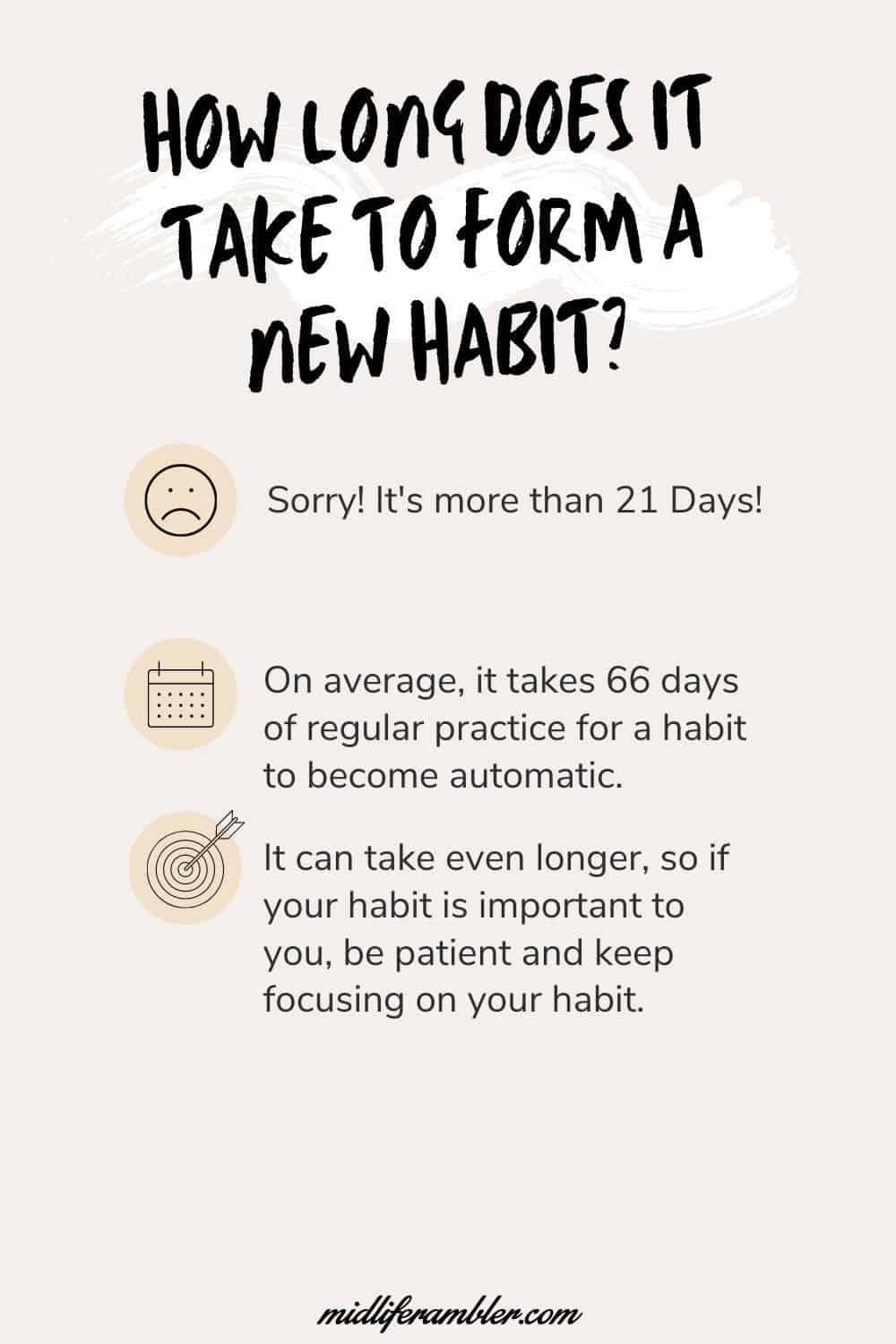
It does not take 21 days to create a new habit. If only! I've read that this myth came from the book Psycho-Cybernetics by Maxwell Maltz. I happen to own that book, so I checked. Maltz actually wrote that it takes a minimum of about 21 days to notice a change in your self-image, not that a new habit is locked in after three weeks. Somewhere along the way, "a minimum of 21 days" got shortened to "21 days." Unfortunately, it is just that: a myth. Studies have shown it takes an average of 66 days for a behavior to become automatic, and anywhere from a few weeks to many months depending on the person and the habit.
You'll Also Love
This shouldn't be depressing news. A habit should be a behavior you want in your life for the long haul, maybe forever. You just need to set your expectations so you know how long it will realistically take for your new habit to feel automatic, and so you don't give up at day 22 because it still feels like work.
When is the Best Time to Start a New Habit?
The New Year, and other "fresh start" times of the year such as Labor Day, the beginning of summer, a birthday or the start of a new school year, are excellent times to start new habits. In her book Better Than Before: Mastering the Habits of Our Everyday Lives, Gretchen Rubin calls this the strategy of the clean slate. Our daily schedules tend to change during these times, so it's easier to build new habits into a new routine than to shoehorn them into an existing one.
If the New Year is your fresh start, it can help to choose one word for the year to guide the habits you pick, or to write a personal vision statement so you know exactly what kind of life your new habits are building toward.
Don't have any "fresh start" occasions coming up anytime soon? That's OK. Spend some time decluttering! Decluttering forces you to examine your life, the things in it, and how you really want to live and spend your time. That can give you the boost of energy you need to jumpstart a fresh start.

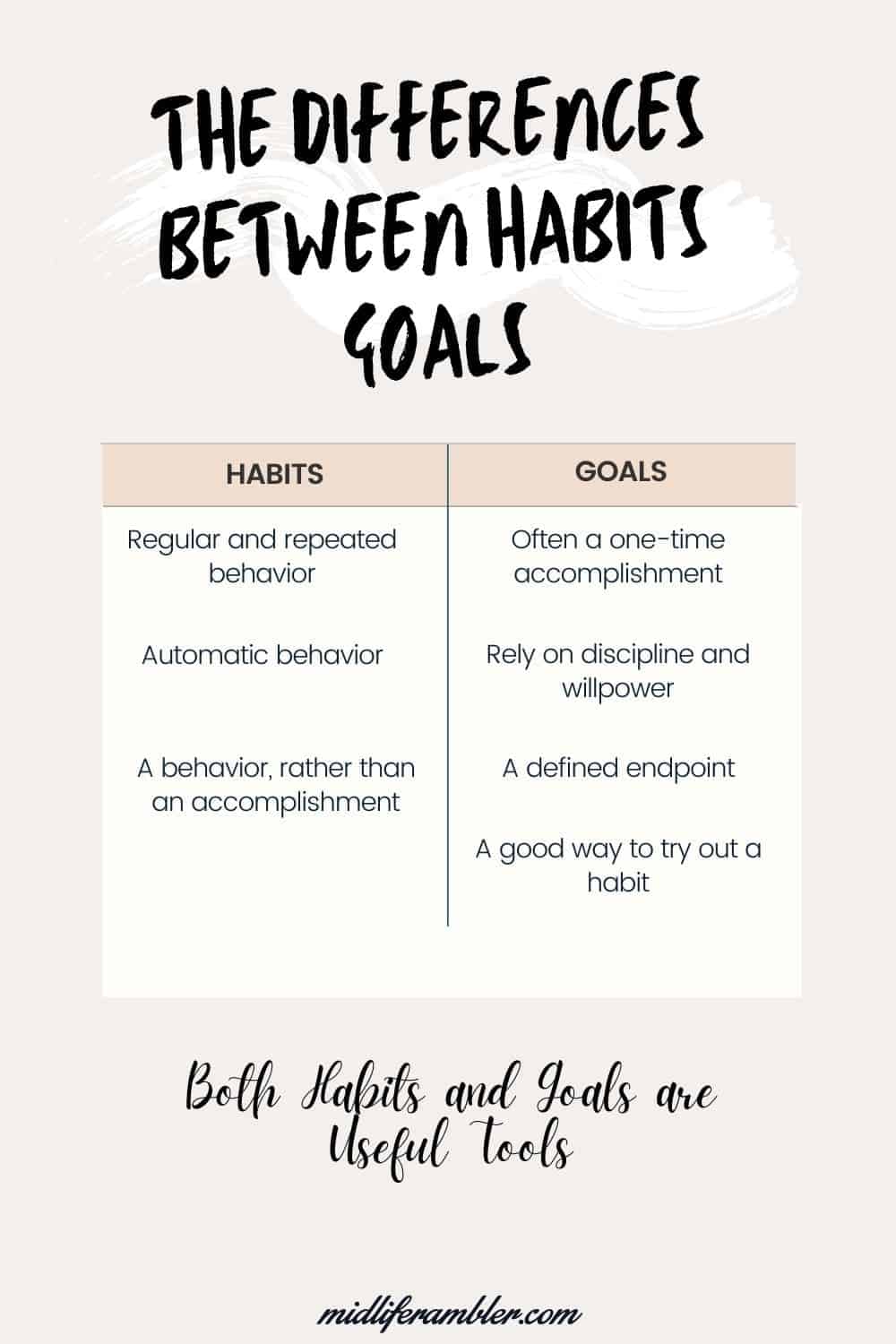
The Difference Between Habits and Goals
If you're anything like me, be prepared to have your mind blown. I learned this while researching this post, and while it makes perfect sense, I had never thought about it before. Once I realized it, so many of my past "failures" at creating habits suddenly made sense.
A goal is not a habit. A goal is a way to try out a habit. A goal is something like "Run a 10K," "Lose 20 Pounds," or "Write a Novel." To reach your goal, you have to show discipline and follow certain habits for a while.
But a goal has a defined endpoint. Eventually, you run your race, lose the weight, or finish the novel. And then you reach a decision point. Do you choose a new goal? Has the habit become so ingrained that you keep going even without a goal? Or do you, like so many of us, "take a break for a bit" that turns into forever?
It's OK to have goals. In fact, it's excellent! Just don't mistake your goal for a habit. When you've reached your goal, you'll need to take some sort of action if you want to keep the habits you started while you were working toward it.
Some people handle this by moving from goal to goal. Most of us, though, need to consciously build new routines that keep our habits in our lives once the goal is behind us. If you love setting goals, making a life goals list is a great way to find the habits worth keeping for the long term.
15 Tips to More Easily Form New Habits
OK, you're ready! You know a bit more about how habits work now, and you're ready to create some new ones in your life. Here are my best tips to make forming new habits a little easier.

1. Define Your Habit
Pick a habit you would like to bring into your life. Here's the key: make sure it's measurable and specific. For example, I really wanted to start drinking more water. After a lot of effort, I had finally cut back to one soda a day (yay, me!), but I kept forgetting to drink water during the day and I was getting visibly dehydrated. "Drink more water" is way too vague, though. So the habit I set for myself was drink 32 ounces of water a day.
2. Define Your "Why"
Sometimes we fail at a habit because it's something we think we "should" be doing, but we don't actually have the motivation to follow through. For years, I vowed to drink more water because, you know, everyone says you should, right? I never followed through.
It wasn't until I noticed how dry my skin and lips were getting that I finally felt motivated. I could see that I really needed more water. At last I was ready to take on this habit, because I was doing it for myself rather than because I "should."
Here's a unique idea that I read about many years ago and have used many times, so I can tell you it really works. Use your phone's camera to film yourself talking about why you want to add this new habit to your life, how it will benefit you and how your life will change as a result. Then watch the video often. You'll be amazed at how powerful this is and how much it helps with the changes you're making.
3. Redefine Yourself
How often have you said something like, "I'm just so bad with money," or "I really hate to exercise"? If you're going to change your habits, you'll need to change the way you see yourself. Take some time to picture yourself as the person who does the habit you're working toward every single day. How is she different from you?
Start to think of yourself as the type of person who does your habit. For example, I'm no longer the type of person who never drinks water. Now I'm the type of person who feels lost without her water bottle, and I carry it with me wherever I go. If you've lost track of who you are lately, these ideas on how to find yourself again are a good place to start.
If this is a big change, like going from total couch potato to running your first 5K, it helps to create a vision board so you can picture your success and start to identify with your new habit. If you'd rather skip the scissors and glue, you can make a digital vision board in just a few minutes.
4. Consider Trialing Your Habit Before Committing to It
Too many of us, myself included, start a new habit intending to do it forever and then beat ourselves up when we quit. The truth is, sometimes we simply don't like the new habit. Maybe you really weren't cut out to be vegan, or it turns out you love carbs too much to give them up forever.
If you're curious about a new habit, consider doing a 30-day trial. If you finish your 30 days with a sigh of relief that it's over, you'll know it's not for you. More likely, you'll end the 30 days with a much better understanding of how to make the habit work for you.
5. Start Small
Now you've defined your habit and you know why you want to start. Your eventual goal is to create your own habit loop that turns into an automatic action. When you're just starting to build a habit, the most important thing is to repeat it every day.
So start small, build a string of successes, and only then increase your habit. I've talked about this before in my tips to finally get in shape after 50.
BJ Fogg, author of the book Tiny Habits, started his habit of daily push-ups with a goal of just two push-ups a day and eventually worked up to 40 to 80 a day.
6. Create a Reminder for Your Habit
You need a way to remember your habit until it becomes automatic. The reminder is the cue in the habit loop you're building. There are several ways to do this, and the best one really depends on what works for you.
Put it on the calendar. Gretchen Rubin talks about this technique in Better Than Before. Like Gretchen, it's one of my favorites because it's so simple. If you want to remember to do something, schedule the time and respect the schedule. That means blocking off 7:30 a.m. every day for your exercise class, or stopping whatever you're doing at 9 p.m. so you can read for twenty minutes before bed. Putting something on the calendar, and most importantly keeping the appointment, is a powerful way to reinforce a habit.
This is also a great way to finally get to the self-care tasks we tend to put off until everything else is done. The problem, of course, is that everything else is never done. But if you put something like "Manicure at 4 p.m." on your calendar, you'll see it all day, and you're much more likely to actually keep that appointment with yourself.
Tie the new habit to an existing habit. This is the strategy I used in my "go to the gym" habit loop: my husband left for work, and I left for the gym. BJ Fogg's push-ups are another example. He did two push-ups every time he went to the bathroom.
Use a visual reminder. A sticky note can be a good reminder, as long as you remember to look at it. I find that changing the note often, or keeping it in my planner where I have to move it, helps. I use a marked water bottle to remind me to drink my water.
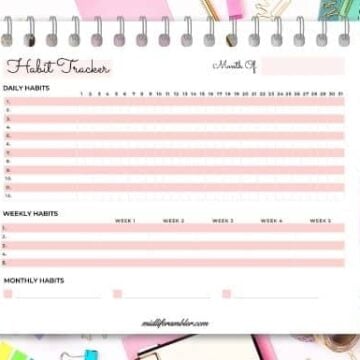
A habit tracker is another helpful reminder for new habits. Seeing that row of empty boxes every morning is a nudge all by itself! You can grab my free printable below, or if you'd rather have everything in one place, a small habit tracker notebook fits easily in a purse or tote.

7. Make Things as Automatic as Possible
The fewer decisions you have to make, the fewer chances you have to decide not to follow your habit.
Meal prepping is an excellent example of making your decisions automatic. If you're trying to eat healthier, make your lunches for the week on Sunday night, when you're well fed and motivated for the week ahead. From personal experience, I can tell you that the motivation to grab a salad is much, much weaker at noon after a long, stressful meeting. Make the decision when you're in better shape to make the right one.
In the same way, I get up every morning and put on my workout clothes first thing. I don't shower and change into my "real" clothes until I've worked out. Sure, some days I'm still in my workout clothes at the end of the day. But more often than not, I eventually give in and work out.
8. Make Your Habit So Easy You Can't Skip It
When I was a single mom, the only time I really had to run was early in the morning before work, so I slept in my running clothes. I put my running shoes and iPod (hey, this was years ago) by my bed. When my alarm went off, I rolled over, put my shoes on, grabbed my iPod, and was out the door before my body fully registered that I was awake.
If you want your habit to be truly automatic, keep looking for anything that makes it harder to practice, then figure out how to remove those obstacles. Sometimes the answer is as simple as moving your exercise equipment where you can see it or hiding the snacks you want to avoid.
9. Make Your Habit Pleasurable
You want your habit to be enjoyable, especially in the early days, when just the thought of getting started can trigger an inner "ugh." One way to do that is to pair something you love with something you're less excited about. I love scrolling short videos, for example, and like most people, I can look up and realize an hour has gone by. So I only let myself watch them on the treadmill.
10. Don't Reward Yourself, Celebrate Your Progress
Rewards for following your habit are a tricky subject. Studies have shown that rewarding children for an activity they already enjoyed made them less motivated to do it on their own.
Personally, I've never been able to motivate myself by promising myself a reward down the line. If I make a deal with myself, like "Work out five times and you can buy that sweater," I'll just buy the sweater whether I work out or not.
Instead of rewarding yourself for hitting a milestone, why not celebrate it? A reward suggests you deserve a prize for finishing an unpleasant task. When you celebrate, you stop for a moment to enjoy and take pride in what you've accomplished. Which sounds better to you?
And don't worry, celebrations can come with presents too. Feel free to get yourself a little celebration gift if you're so inclined. ;)
11. Add Accountability to Your Habit in a Way That Works for You
It helps to have some form of accountability when you're starting a new habit. Just make sure it's a kind that works for you.
Some people do well with an accountability partner they meet up with regularly to practice their habit. Others actually do worse. You know how it goes. For every pair of running buddies who faithfully meet every Saturday morning, there are two workout partners who plan to meet twice a week before work, and somehow every week one of them is too busy, so neither one works out.
You might also have a friend or partner you report your progress to, or a coach you check in with. There's an online group for almost any habit you might be trying, and these groups offer tons of support, advice and accountability. I personally find support from strangers to be highly motivating.
No matter what type of accountability you choose, research shows that adding some form of accountability increases your chances of sticking with your new habit.
12. Plan for Failure
I know! So depressing. But the truth is, you'll probably mess up. In fact, you can probably think of a few situations right now where it might be hard to practice your habit. The key is preparation. For example, if you know you tend to give in and overeat when you're out with friends, make a plan beforehand. Decide exactly what you'll order instead of simply vowing to yourself that "this time will be different."
13. Beware of Loopholes
Ah, the loophole. Gretchen Rubin devotes an entire chapter to loopholes in Better Than Before, and with good reason. Loopholes are the thin end of the wedge: the seemingly innocent, perfectly reasonable beginning of the end of a good habit we've been oh so faithfully following.
What does a loophole sound like? Something like this:
- I can't possibly work out this week; I'm just too busy at work.
- I'm too stressed to eat healthy; I need this comfort food.
- I know I said I would go to bed every night at 10:00 p.m., but I had to finish that last chapter.
- I'm usually so good! This one time won't matter.
Rubin describes ten types of loopholes, but they all boil down to the same thing: a justification we spit out in our heads once we've already decided to break our habit. If you hear yourself using a loophole, you have two choices:
- Catch yourself and go back to your habit.
- Say out loud, "I'm choosing to break my habit right now."
Note: this is my advice, not Rubin's. She says you should always go back to your habit, but sometimes we're just not that strong. If that's the case, acknowledge what you're doing and don't justify it.
14. Track Your Progress, Even - Especially - If You've Failed
It's essential to track your progress. I use a habit tracker to record whether I completed my habits each day, so I have a nice yes/no record to look back on. If you love the satisfaction of a streak, a scratch-off streak calendar on the wall makes every day you show up feel like a small win.
If I'm trying to lose weight, I also like to track what I'm eating.
Track your habit, even - especially - if you've failed. Dieters, and by dieters I mean me and probably you, are the worst about this. We eat a bunch of cookies, and that's all we think: we've eaten a bunch of cookies. At some point in the cookie eating, we decide we're not going to track this. So we don't even know how many cookies we've eaten. Is it six? Twelve? Forty?
That's exactly the information we need. The truth is, we probably ate twelve cookies, and knowing that is actually reassuring. But even if the answer is forty, not tracking sends us into a shame spiral that's hard to recover from. We won't start tracking again until the next day at the earliest, and maybe not until the following Monday, or never. Show yourself the grace you'd show anyone else: forgive yourself, track what you can, and start over.
15. Make Adjustments As Necessary
This is where my successful gym habit loop fell apart. My habit loop was built around going to the gym, not around working out or exercising in general. So when my gym closed for months, I simply stopped my habit instead of adjusting it to the new circumstances.
That, of course, is exactly what not to do. If you're consistently missing your habit, or it's getting harder, take a look at your situation and see how you can make the habit more automatic or more manageable. Or revisit your motivation. Maybe the habit really isn't as important to you as you thought.
Or maybe you're really rocking it, and it's time to take things up a notch, add five minutes of meditation, or check out a retreat. As you review your habits every so often, you'll spot opportunities to change and expand what you're doing.
Good Books About Creating New Habits
If you'd like to read more about creating new habits, these are some of the best books I've read on the subject.

Atomic Habits by James Clear
If you only read one book about habits, make it this one. Like The Power of Habit, it explains the science of how habits form, and like Better Than Before, it's packed with practical advice you can use right away. It's well written, easy to read and full of real-life examples, including the idea of getting just 1% better every day.

Tiny Habits by BJ Fogg
Stanford researcher BJ Fogg makes the case for starting so small you can't fail, like his famous two push-ups a day. It's a reassuring read if big resolutions have let you down before, and his method of tying a tiny new habit to something you already do every day really works.

Better Than Before by Gretchen Rubin
Rubin breaks the science of habits into short, easy-to-digest nuggets with advice that's simple to put into practice in real life. Her chapters on scheduling, the clean slate and loopholes shaped a lot of the tips in this post. She and her sister also have a fun podcast called Happier with Gretchen Rubin that's worth a listen.

The Power of Habit by Charles Duhigg
If you want the science behind habits, this is the book for you. It isn't dry, though: it's a fascinating look at how habits shape our lives and how companies use them to influence us. The habit loop it describes is a great way to understand how to change a bad habit. Duhigg also hosted a podcast called How To! with Charles Duhigg.

Good Habits, Bad Habits by Wendy Wood
Psychologist Wendy Wood spent decades studying habits, and her big takeaway is a relief: willpower isn't the answer. She shows how to shape your surroundings so good habits get easier and bad ones get harder, which is great news for anyone who's tired of white-knuckling it.
Frequently Asked Questions
How long does it take to form a new habit?
Longer than the 21 days you've probably heard! Research puts the average at about 66 days for a new behavior to feel automatic, and it can take anywhere from a few weeks to several months depending on the habit and the person. Simple habits, like drinking a glass of water with breakfast, stick faster than big ones like a daily workout.
What's the easiest way to start a new habit?
Start tiny and tie it to something you already do every day. "After I pour my morning coffee, I'll write down one thing I'm grateful for" is far easier to stick with than "I'll journal more." Make it so small you can't skip it, do it every day, and only make it bigger once it feels automatic.
What are good new habits to try?
The best new habit is one you actually want in your life. If you're looking for ideas, here are some easy habits that are especially good for women over 40:
- Drink a glass of water first thing in the morning. Your skin will thank you.
- Take a 10-minute walk after dinner. It's good for your blood sugar, your mood and your sleep.
- Do a few minutes of strength training or stretching. Muscle and flexibility matter more every year.
- Read for 20 minutes before bed instead of scrolling your phone.
- Write down three things you're grateful for each morning or night.
- Go to bed at the same time every night. Hello, better sleep!
- Spend 15 minutes on a hobby you love. Need ideas? Here's how to find a hobby as an adult.
- Tidy one small spot each day, like the kitchen counter or your nightstand.
What's the difference between a habit and a goal?
A goal has a finish line, like running a 10K or losing 20 pounds. A habit is something you do automatically, over and over, with no end date. Goals are a great way to try out a habit, but once you reach the goal you need a plan to keep the habit going, or it tends to fade.
So, what new habit are you starting first? Pick one, make it tiny, and grab your free habit tracker so you can watch those checkmarks add up!
Let's talk.